
Let’s say, you run a background screening platform.
You pull data from courts, registries, vendors, and public sources. Some day, you discover that one person shows up three times in your system:
- “Robert J. Smith”
- “Bob Smith”
- “R. Smith”
Different sources. Slightly different addresses. Same date of birth.
Your system treats them as three people.
That leads to duplicate checks, inflated record counts, and confusing reports. Worst case, you attach the wrong record to the wrong person.
Entity resolution fixes this by answering a basic question your system can’t solve on its own: “Are these records about the same real human?”
In this guide, you’ll get a full entity resolution guide: what it means, how it works, when to use it, and how to evaluate solutions, so you can avoid costly mistakes and get a reliable view of your data.
What Is Entity Resolution?
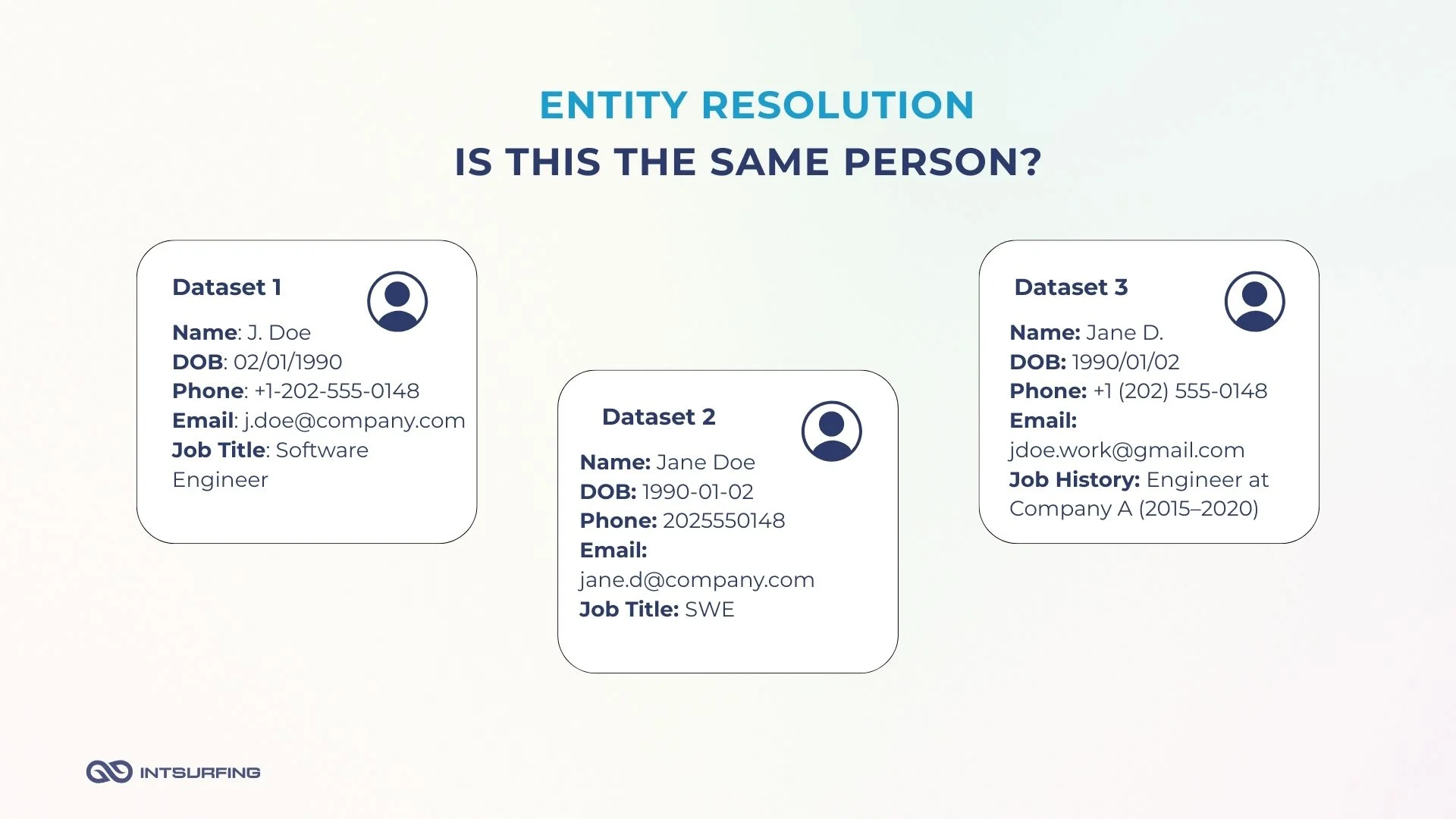
Entity resolution (ER) means the process of finding out when different records actually refer to the same entity—a person, organization, or place. It links and merges those records, even when the data is inconsistent, duplicated, or incomplete.
Why Entity Resolution Matters
When your systems can’t tell that multiple records belong to the same person, the cost shows up everywhere.
- Bloated customer lists. Duplicate signups and typos inflate your “unique” counts and waste marketing spend. One person may receive the same campaign twice, while another is missing from reports.
- Fragmented background data. Screening pipelines pull records from courts, counties, and national sources. Without resolution, you risk merging the wrong files or missing true matches—causing disputes, slower decisions, and client distrust.
- Fraud and KYC failures. Fraud networks thrive on aliases and shell accounts. The 2023 Identity Fraud Study found U.S. losses reached $43 billion in 2022. Detecting hidden links requires strong record matching, not just surface-level checks.
- Misleading reports and decisions. Bad data makes dashboards and forecasts unreliable. Gartner estimates poor data quality costs organizations $12.9 million per year—money lost simply because the underlying records don’t align.
When you resolve entities correctly, you get one clean lens on your business: fewer duplicates, consistent compliance checks, and analytics you can trust.
ER vs Related Terms
Entity resolution often overlaps with other terms you may have seen in data or AI discussions. This quick entity resolution explained section shows how it differs from identity resolution, record linkage, and entity linking—plus simple examples to make the differences clear.

Entity Resolution vs Identity Resolution
Entity resolution is about figuring out whether multiple records refer to the same thing — a person, company, address, device, or product. Identity resolution is narrower. It focuses only on people and usually on recognizing the same person across systems, sessions, or channels.
Example If you’re merging “ACME Inc.” and “ACME Corporation” into one company record, that’s entity resolution. If you’re figuring out that a website visitor, a mobile app user, and an email subscriber are the same human, that’s identity resolution.
Entity Resolution vs Record Linkage
Record linkage is the technical act of connecting records that seem related. Entity resolution goes further — it decides whether those linked records truly represent one entity and often creates a unified entity as a result.
Example You may link two records because they share a name and date of birth — that’s record linkage. When you confirm they describe the same person and merge them into a single profile, that’s entity resolution.
Entity Resolution vs Entity Linking
Entity resolution works inside your data. Entity linking connects your data to an external reference or knowledge base. One decides “are these the same?” The other decides “what well-known thing is this?”
Example Merging “Apple Inc” and “Apple, Incorporated” in your CRM is entity resolution. Connecting “Apple Inc” in your database to a public company profile in an external database is entity linking.
How Entity Resolution Works
Think of entity resolution as a journey your data takes. It starts messy and fragmented, then step by step becomes one clean, reliable view.
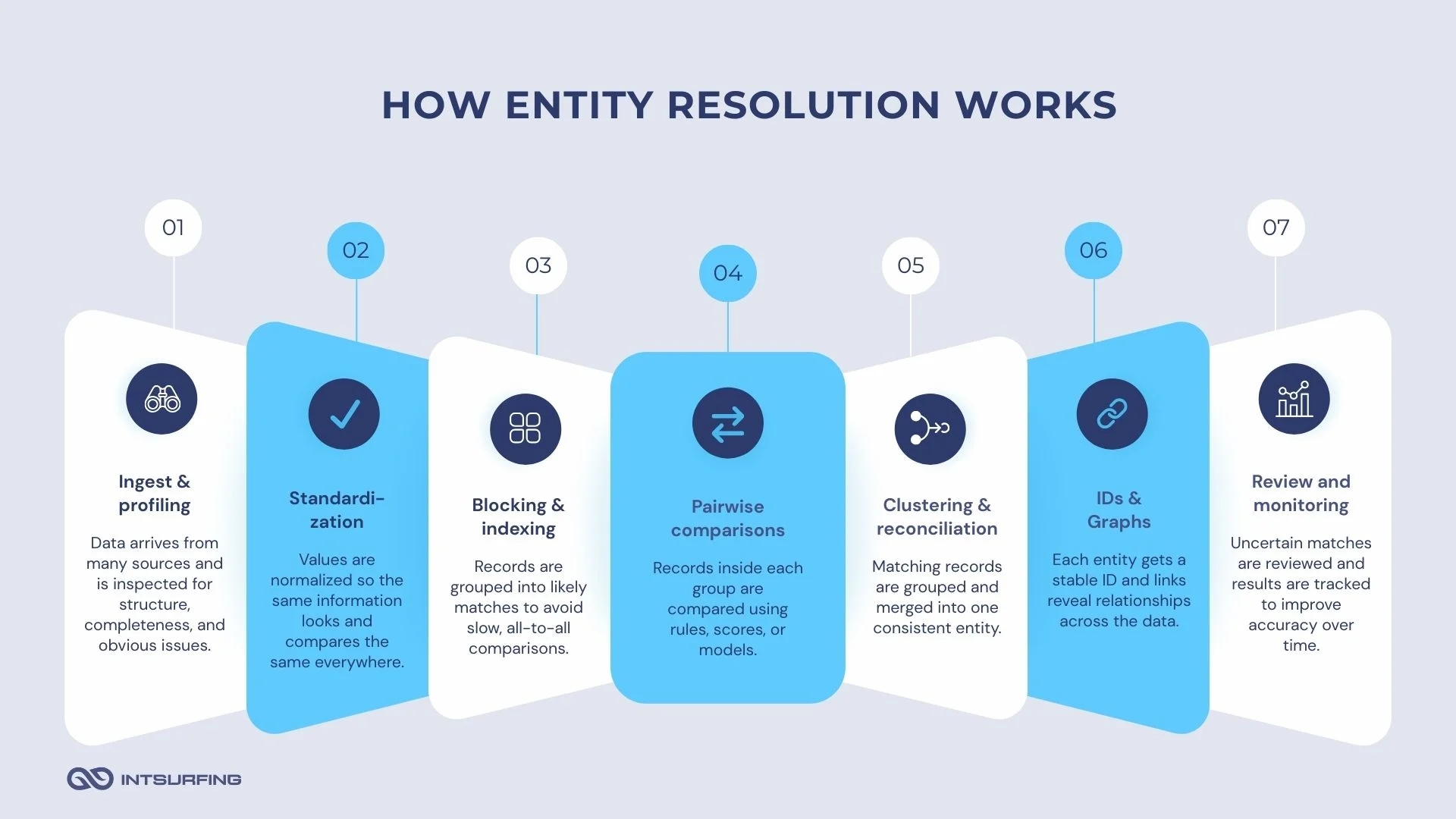
- Ingest and profiling. Data flows in from CRMs, payment processors, or court databases. The first step is to profile it: what fields exist, how complete they are, and where obvious errors lie.
- Standardization. Formats are aligned, so comparisons make sense. “NY” becomes “New York,” dates are normalized, phone numbers shaped the same way.
- Blocking and indexing. Instead of comparing every record to every other one, the system groups likely candidates—similar to sorting files into folders. This makes entity matching faster and more accurate.
- Pairwise comparisons. Within those groups, the system measures how closely records align on names, addresses, or IDs. Deterministic rules may require exact matches on government IDs, while probabilistic or ML models weigh multiple signals.
- Clustering and reconciliation. Likely matches are clustered to represent one real-world person or organization. This is where deduplication vs entity resolution matters: deduplication just removes obvious duplicates, while resolution applies survivorship rules to keep the most relevant data and produce a “golden record.”
- IDs and graphs. Entities are assigned unique IDs and can be mapped in a graph to reveal households, company networks, or shared addresses.
- Human review and monitoring. Low-confidence cases go to a reviewer, and the pipeline is monitored, so accuracy improves over time.
That’s entity resolution basics in action: a messy stream of inputs transformed into a clean profile you can actually run your business on.
Metrics That Show If Data Matching Works
Most entity resolution tools output a confidence score—a number between 0 and 1 that shows how likely two records refer to the same entity. But confidence isn’t ground truth. A “0.95” score doesn’t guarantee 95% accuracy; it’s just the model’s estimate.
To know whether your system really works, you need tested metrics:
- Precision tells you, of all the matches made, how many were correct.
- Recall tells you, of all the true matches that exist, how many were found.
- F1 score balances the two, so strong precision can’t hide weak recall, and vice versa.
Here’s a plain example: imagine you truly have 100 duplicate pairs. The system finds 80, and 70 are correct. That’s precision = 87.5%, recall = 70%, and the F1 score ≈ 78%, showing recall is pulling performance down.
As for targets, in high-risk areas like fraud or background screening you usually want precision above 95%—false merges are too costly. Recall varies by use case: compliance teams push for very high recall, while marketing may accept lower recall if precision is excellent.
A practical KPI for managers is the clerical review rate—the share of cases that still need human review. Too high, and costs balloon; too low, and bad merges slip through.
In short, precision, recall, F1, and review rate show whether your entity resolution pipeline is actually improving record matching—not just producing confident-looking scores.
Common Use Cases
Entity resolution shows up wherever fragmented records create risk or waste. Here are four areas where it makes a measurable difference.
Background screening. Criminal data from courts and counties often arrives in inconsistent formats. Without ER, expunged or duplicate records can reappear in reports. In PeopleFacts’ 2025 class action, the screening firm agreed to a $2.4 million settlement over alleged failures in notifying candidates under FCRA rules when reporting background findings. ER reconciles identifiers and suppresses outdated files, cutting disputes and keeping checks compliant.
People-search and ID verification. Identity data lives across brokers, bureaus, and utilities. Without ER, the same person may appear under multiple variations—or not at all. According to the 2024 NIJ study, nearly 90% of individuals in private checks had at least one false negative (we’ve written more about this in our post on false positives and false negatives in background checks). ER merges fragments into a single profile, speeding up onboarding and reducing disputes.
eCommerce and CRM. Duplicate customer profiles waste marketing spend and skew reporting. The Plauti analysis of 12 billion Salesforce records showed that 45% of new entries were duplicates. Entity resolution consolidates multiple signups and loyalty accounts into one “golden record,” so campaigns and analytics reflect reality.
Financial crime detection. Fraudsters hide behind aliases, funnel accounts, and shell companies. Regulators see the scale: FinCEN’s 2025 advisory tied $312 billion in suspicious transactions to laundering networks built on webs of identities and companies. ER surfaces these hidden links—shared addresses, reused phones, overlapping directors—so compliance teams can spot risky networks early.
Should You Build or Buy Entity Resolution?
The answer depends on cost, speed, and what your business really needs.
Building in-house gives you control. You decide how records are matched, how rules evolve, and you keep data fully internal. But the cost is steep. Industry experts estimate that a basic in-house ER engine takes 12–24 months and $1–5M to reach production, while pushing toward enterprise-grade accuracy (≥85% confidence at scale) can exceed $30M over several years.
Buying or outsourcing gets you to results faster. Proven pipelines are ready-made, deployment takes months, and costs scale predictably with usage. The tradeoff is less transparency if the vendor uses black-box scoring, and sometimes stricter data residency questions.
| Factor | Build makes sense if… | Buy makes sense if… |
|---|---|---|
| Volume | <500K records/day, stable load | Millions/day, fast growth |
| Update cadence | Mostly batch updates | Real-time onboarding, fraud checks |
| Transparency | Regulators demand explainable logic | Confidence scores + audit trail are enough |
| Budget | $5M+ and strong internal team | ROI expected in <12 months |
| Tech stack | Modern ML/ETL team available | Legacy stack, need fast integration |
In one Intsurfing project, we matched 400M records in ~40 minutes, achieving 76% deduplication at ≥85% confidence on AWS Spark. That’s the kind of speed and accuracy that can take years to replicate in-house. If you’re under pressure—tight deadlines, fragmented sources, or legacy systems—a managed team is often the fastest route forward.
10-Minute Evaluation Checklist
If you only have a few minutes with a vendor—or even your own data team—these are the questions that tell you whether their entity resolution pipeline is ready for real-world use.
- What blocking strategies are used? Blocking determines which records get compared. Weak blocking can miss true matches or waste compute on irrelevant pairs.
- How are confidence scores explained? Ask how the system calculates match probabilities. If the vendor can’t explain why a record scored 92% instead of 55%, it’s a black box—and that’s a risk.
- Is there human-in-the-loop review? No algorithm is perfect. You need a process for manual review of edge cases, or disputes will pile up.
- Can matches be audited and reproduced? Regulators and clients may demand to know why two records were linked. A full audit trail is essential.
- How is sensitive data handled? Confirm data residency (where it’s stored), deletion processes, and compliance with GDPR/CCPA/PCI if financial or PII data is involved.
- What are the cost drivers? Some vendors charge per record pair, others per feature or transaction. Understand how costs scale with your growth.
- What are the latency targets? Is the pipeline tuned for batch updates, or can it deliver matches in seconds for fraud/KYC checks?
- How are models updated and versioned? If algorithms change, can you reproduce past results for audits and SLAs?
- What KPIs are tracked? Expect to see precision, recall, F1, and clerical review rate. These are the health signals of an ER system.
Conclusion
Entity resolution enables you to keep reports accurate, reduce compliance risk, and actually trust the numbers in front of you. Whether you build or buy, the goal is the same: a reliable view of people, organizations, and transactions. At Intsurfing, we design and run ER pipelines as part of broader data quality and integration work—helping you move from messy inputs to clear, auditable outputs.
FAQ
Q: Is entity resolution the same as deduping?
A: Not exactly. Deduplication removes exact or near-duplicate records. Entity resolution goes further: it links records that may not look alike—different spellings, missing fields, or alternate identifiers—but represent the same real-world entity.
Q: How accurate can entity resolution be?
A:No system can be 100% accurate. Matching depends on the quality of your data and the thresholds you set. At Intsurfing, we aim for accuracy levels that meet your business logic—for example, ≥85% confidence while keeping clerical review manageable.
Q: Can LLMs replace entity resolution?
A: Large language models can assist with tasks like parsing names or addresses, but they don’t replace the structured, auditable matching pipelines that regulators and clients require. Think of LLMs as helpers, not substitutes, for ER.
Q: What data do I need to start?
A: At minimum: consistent identifiers (names, dates, addresses, IDs) and access to the main sources you want to link. The more structured and complete the inputs, the better the resolution. We can help profile your data to show what’s realistic before you invest further.